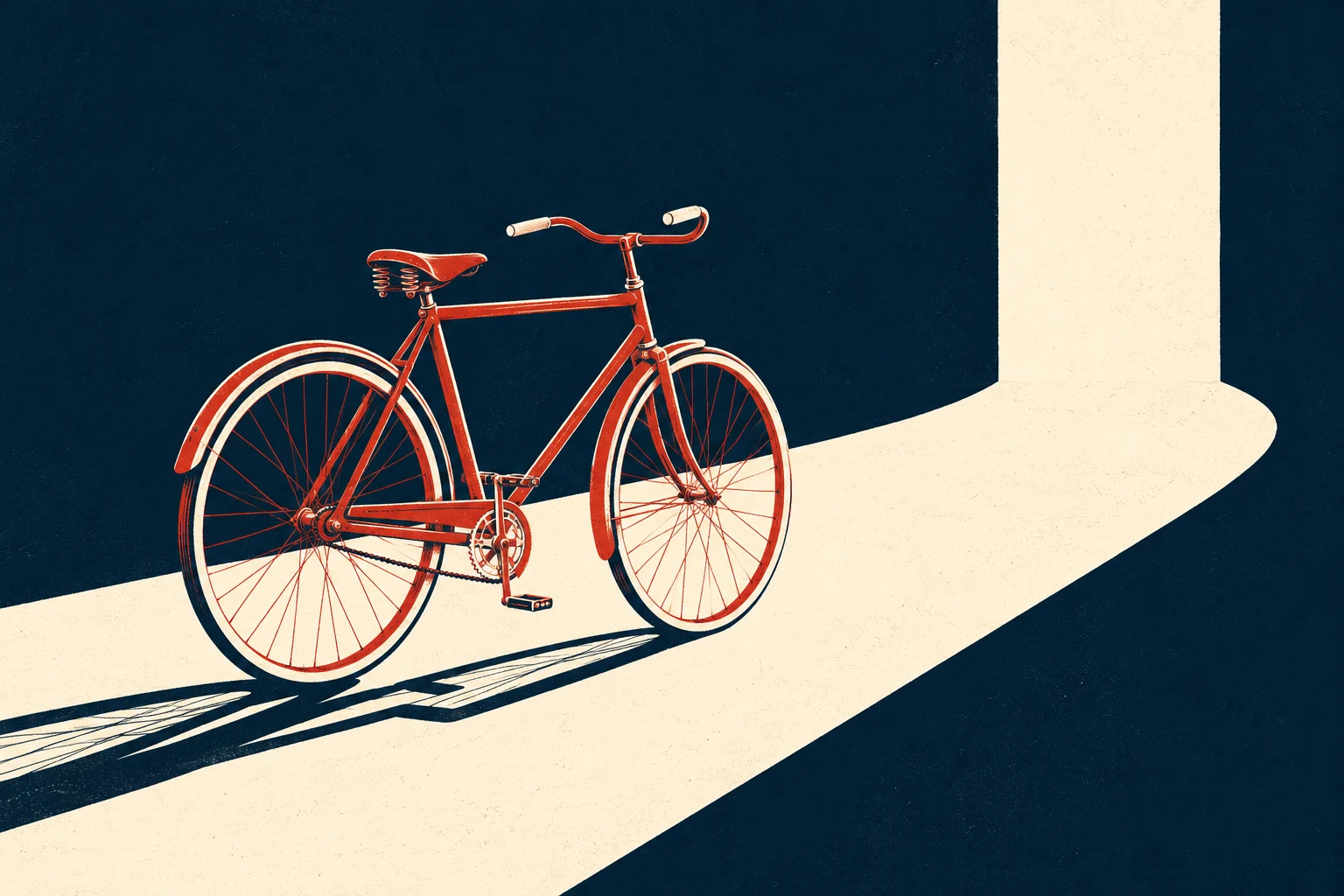
Frances Willard needed other people to hold the bicycle still while she climbed onto it. At first there were three young men, then two young women working to keep her balanced, then one person walking beside her. Eventually she could manage without someone holding the machine. She still wanted someone close enough to help.
In the short book she published in 1895 about learning to ride, she remembered the instruction she kept giving her helpers: “Let go, but stand by.”1
Willard was in her fifties. She had spent years teaching, writing, speaking, and organizing. Following the death of her mother and a period of exhaustion, she wanted an activity that would take her outside and ask something different of her. The bicycle was a gift from her friend Lady Henry Somerset. She called it Gladys. Learning to use it meant being visibly bad at something after a long career of being useful to other people.
The small practical problems matter. She could learn to pedal, turn, and get off before she could reliably get on. Knowing how to operate a machine once seated was different from being able to start. Her account includes lessons in an unpleasant indoor gallery in Chicago, anxious friends, a painful fall, and the gradual discovery that she did better after resting. The story of a new capability, told by the person trying to acquire it, is less smooth than the story told by someone selling it.
There is an earlier loss in her account. As a child, she had made a little plow, worked outdoors, and used tools. At sixteen, the clothes and behavior expected of a young woman began to restrict those activities. She recalled long skirts, a corset, high heels, and pinned-up hair. She remembered writing that her occupation was gone. Her later life was hardly empty: it included a substantial public career. But she understood that becoming respectable had meant giving up a way of occupying the world with her body.
The bicycle offered a partial return. It also asked her to learn something new. This makes it a useful place to begin a history of technological change. We should encounter a machine that enlarges a life before deciding that machines mainly take people's places away.
Source notes
- Frances E. Willard, A Wheel within a Wheel: How I Learned to Ride the Bicycle, with Some Reflections by the Way (New York, Chicago, and Toronto: Fleming H. Revell, 1895), especially printed pp. 9–26 and 37–42, “Preliminary,” “The Process,” and “Companionship.” Public-domain transcription, Project Gutenberg, accessed October 18, 2026. The scenes and the short quotation come from Willard's retrospective first-person account; her predictions about all women are not adopted as established outcomes. ↩