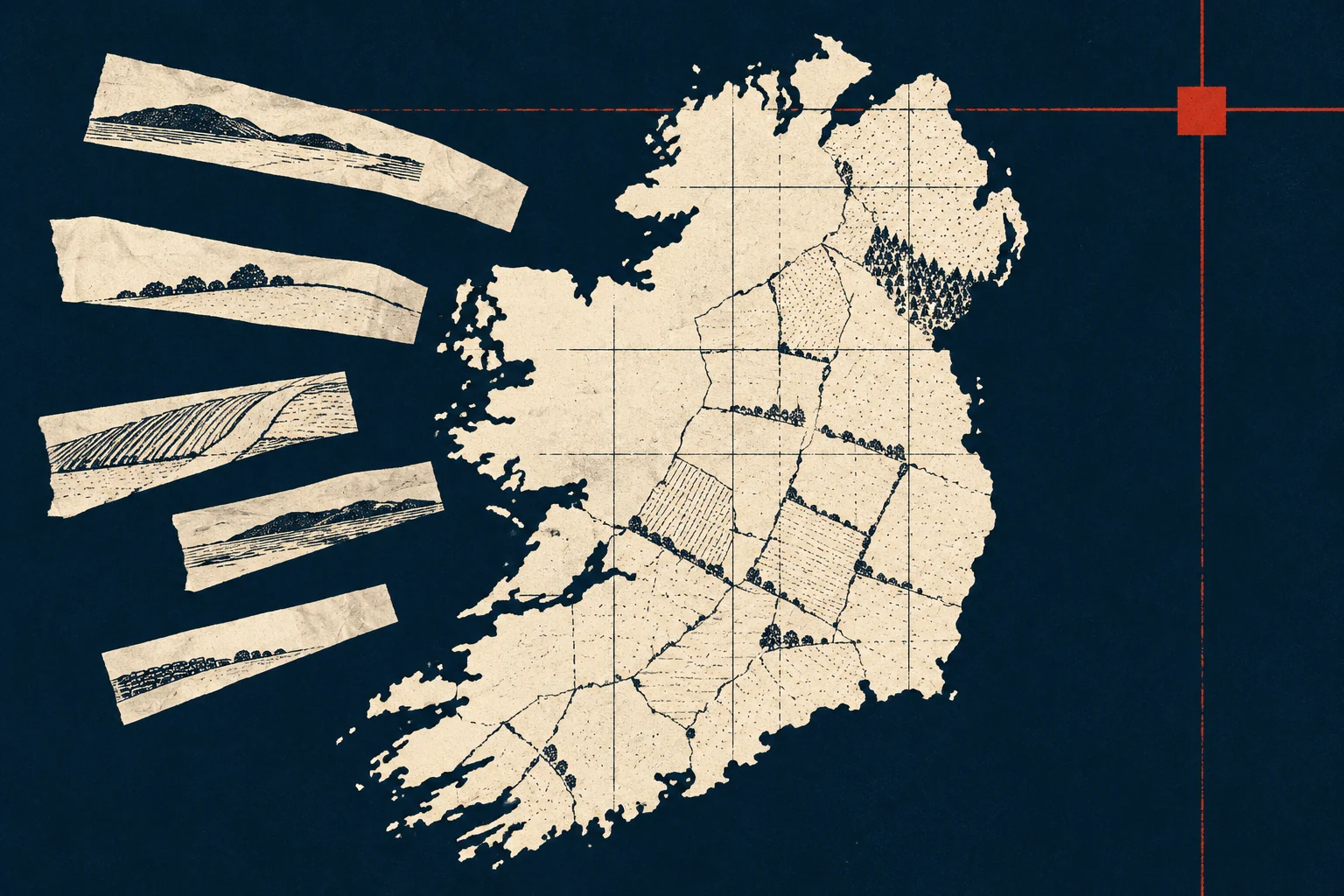
On 27 October 1839, John O'Donovan wrote from Kilkee that he needed square paper.
He was in County Clare working for the Ordnance Survey. Communications had failed to catch up with the traveling fieldworkers. He wanted letters redirected, confirmation that books sent to Dublin had arrived, and a copy of a poem about the Shannon forwarded from another correspondent. A request for paper sat among requests for scholarship and reassurance about the post.1
It is a good opening to an Irish history of displacement because nobody has yet left the country. The problem is how a country becomes knowable to an administration, and what happens to the people who already know it.
The paper matters. So do the postmasters, the books, the measurements, and the scholar who can move between an Irish name and an official entry. A survey is not produced by a distant mind looking down at the island. It is assembled through journeys, requests, interruptions, judgments, and supplies. Its apparent completeness comes later.
O'Donovan's nearby description of Gleninagh gives dimensions for the old church and discusses the name's Irish form. He translates Gleann Eidhneach as an ivy-covered valley. Other entries identify a well, a heap of stones, a fort, and traditions attached to the landscape. He distinguishes what he sees, what he thinks the correct name should be, and what local people believe. The finished record contains more than coordinates. It contains decisions about which kinds of knowledge belong in which places.
For someone who has never lived in a world of oral placenames, the stakes can be difficult to see. A name is not only a label attached to an object. It can be a compact instruction, a remembered person, an account of terrain, or a route into a story. A pronunciation may locate someone socially as well as geographically. A printed map can preserve a name wonderfully while changing who has authority to settle its spelling.
My Irish identity makes these questions personal, but it does not supply a family history I can claim without evidence. Nor does it make every Irish experience mine. The task is to attend to particular people and particular changes, including the changes undergone by people who stayed. A country can remain on the map while the terms of belonging within it move.
Source notes
- John O'Donovan, letters of 27–29 October 1839 and Gleninagh description, “Parish of Gleninagh (a),” Clare Libraries. Published transcription read in indexed text, including requests for square paper, redirected letters, books, and the Shannon poem. The edition derives from later typescripts; original manuscripts were not inspected. ↩