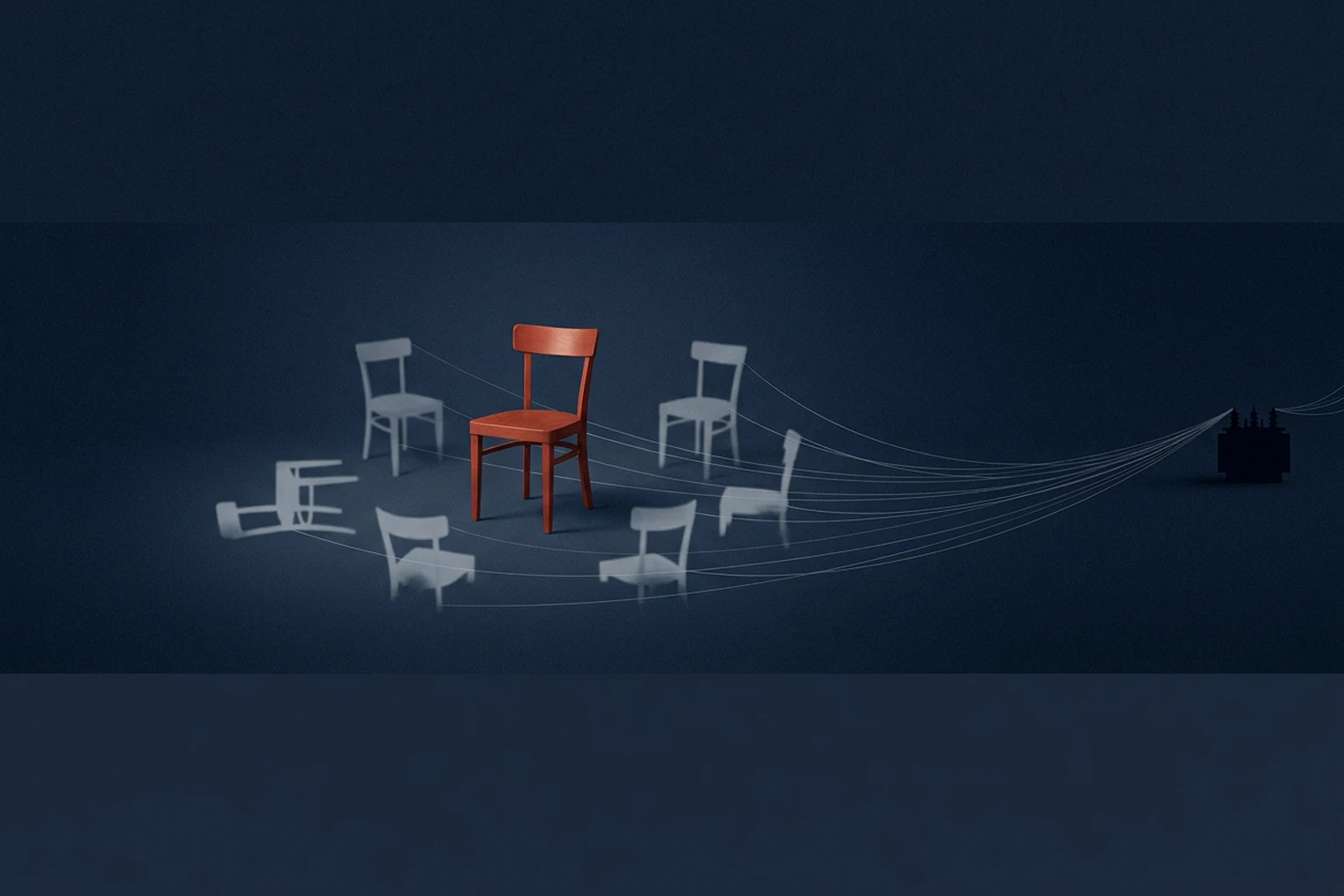
A study published November 9 in Nature Energy asked a simple question about the AI boom: who pays for the power grid it requires, and who benefits? Cheng Feng and Fengqi You at Cornell analyzed four major U.S. grids from 2020 through 2025 — the southern Bay Area, north Texas, the Midwest, and the mid-Atlantic — using rate filings, transmission plans, and federal household data. The study itself is the primary document; the Cornell Chronicle's write-up is the readable version.
The short answer is that data centers paid, on average, 38 percent of the infrastructure costs their growth triggered — $3.12 billion of an $8.25 billion bill in 2025. The remaining $5.13 billion fell largely on residential customers. Transmission investment across those grids rose from $2 billion in 2020 to $34 billion in 2025, data centers driving much of the rise. In the most exposed hubs, wholesale electricity prices rose more than 10 percent by 2025 — 15 percent in Virginia, 20 percent in the southern Bay Area. Residents of New York and New England, where little has been built, have not seen the same increases. You do not have to live next to a data center to help pay for its power lines; people in New Jersey and Ohio are helping pay for grid upgrades linked to Virginia's.
The distribution is the part that should bother us. The share of rural families carrying a high energy burden — more than 6 percent of income going to energy — rose 76 percent more than among urban households. The lowest-income households face extra energy costs reaching, in the worst cases, 28 percent of their incomes. And the survey work the authors cite finds rural residents are the least likely of anyone to use AI tools. The people paying the largest share of the bill are the people least served by the product.
I keep coming back to what this means for the argument I make in the book. Unplacement is what happens when the place a person expected to occupy — a job, a career start, a footing — becomes harder to find. This study describes a second disruption on the same spending: the buildout that displaces work also raises the power bills of the households least able to absorb it. Losing a footing is hard enough. Paying, on your own meter, for the infrastructure that displaced you is a different category of injury. The bill arrives before the benefits do.
The researchers point at fixes that exist today: charging large facilities for the demand they actually add, shifting data center load off peak hours, directing funds to low-income households the way Minnesota's law does. Who pays for the grid is a choice, not weather.
That is the real challenge. Not whether AI eventually creates more jobs than it removes — nobody can settle that yet — but who pays, starting now, while the thing settles in. Two disruptions, one bill, the same households on the hook for both.